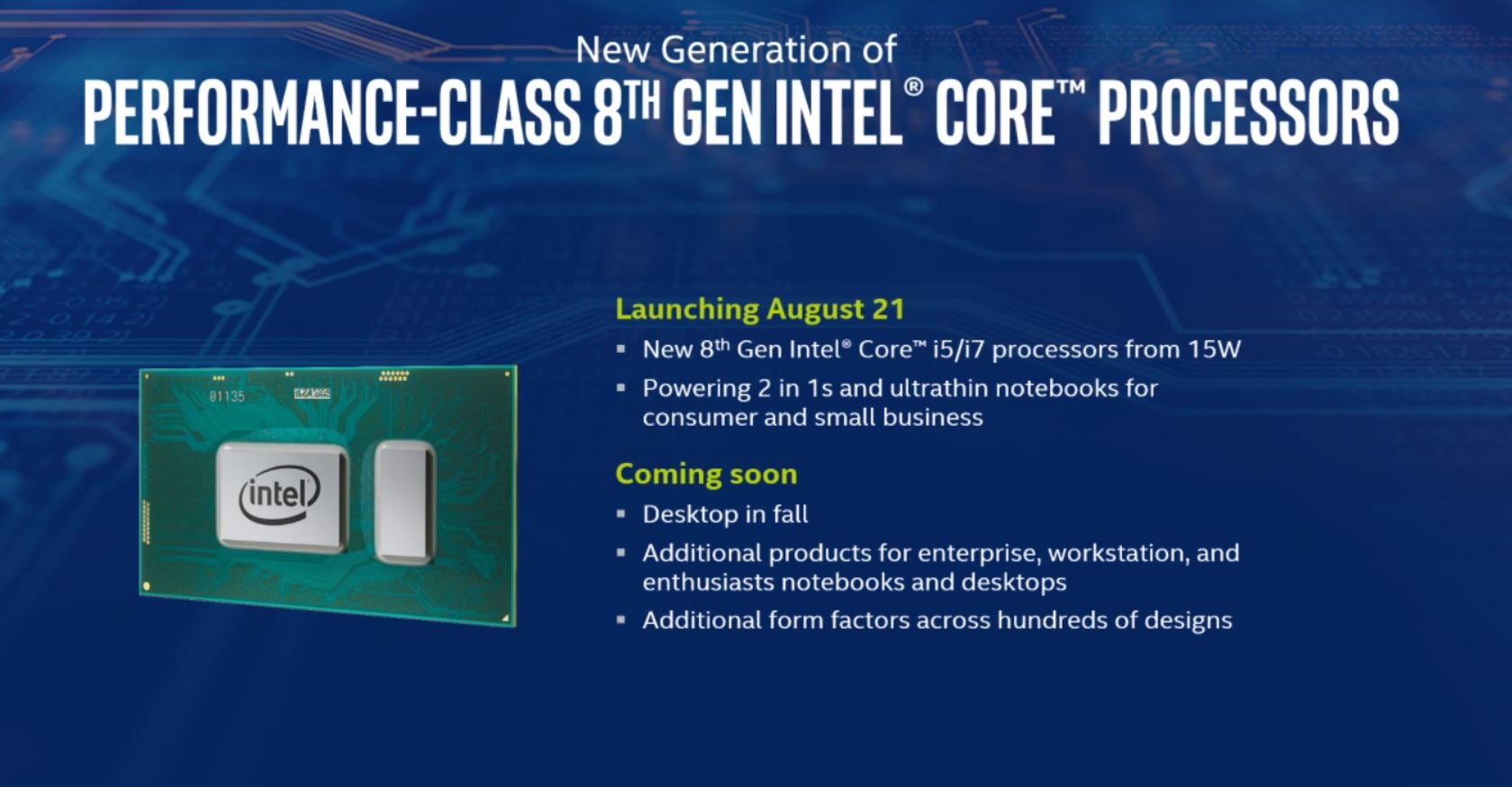
Intel has finally shown its hand in the 2017 CPU wars, revealing the processors that'll power the laptops going on sale before Christmas this year. We still don't have firm details on the expected 'Coffee Lake' desktop chips yet, but this piece will contain everything Intel has officially revealed along with some extra juicy rumours about what's coming up.
The latest big news in the world of 8th-gen Intel processors are the specifications of its desktop chips. If you want more information on the laptop parts, which are quite different, scroll down to the next section.
If you're thinking of building a gaming PC soon, the news of Intel's "Coffee Lake" 8th-gen processors will be music to your ears. Coffee Lake is the next-generation architecture for Intel processors and the successor to Kaby Lake, which will still be used in the laptop chips discussed below. In short, if Kaby Lake was a refined version of Skylake, Coffee lake is super-duper refined (also known as 14nm++).
In terms of specifications, a massive leak from a German online retailer has given us practically everything we need to know, assuming the leak is actually accurate and not a hoax to gain publicity. The table below shows the specifications of the entire "S"-line desktop chips you'll be able to buy for your next gaming PC.
Cores/Threads
Base clock (GHz)
Turbo all cores/one core (GHz)
L3 cache
TDP
Price (EU, inc VAT)
i7-8700K
6/12
3.7
4.3/4.7
12MB
95W
€388
i7-8700
6/12
3.2
4.3/4.6
12MB
65W
€327
i5-8600
6/6
3.6
4.1/4.3
9MB
95W
€273
i5-8400
6/6
2.8
3.8/4
9MB
65W
€192
i3-8350K
4/4
4
–
8MB
91W
€189
i3-8300
4/4
4
–
8MB
65W
?
i3-8100
4/4
4
–
8MB
65W
€123
The clear big difference here between this year's 8th-gen chips and last year's 7th-gen products are the number of cores. Core i7 chips have gone from quad-core to six-core, as have Core i5s. Core i3, meanwhile, is now a quad-core brand.
As far as pricing goes, despite the extra cores, prices haven't increased horribly over last year. Right now you can grab a Core i7-7700K for around £320, while its six-core successor, the 8700K, looks to cost around £350 in UK money including taxes. That's not bad at all considering the expected massive performance increase.
The other thing that's worth keeping in mind ahead of the 8th-gen desktop chip launch is that it will require a new chipset, called Z370. This means the Z270 chipset that was introduced for Kaby Lake is already defunct and won't accept any newer processors. That's a bit of a bummer for anybody who made what they were hoping was a long-term investment in a Z270 motherboard.
Intel 8th-generation Core laptops
Intel's first drip of information on its new 8th-generation chips will be music to the ears of people looking to buy a laptop before the start of 2018. From 7th-generation 'Kaby Lake' to 8th-gen 'Kaby Lake' (you read that right, we'll explain later, we promise), Intel is claiming a "once in a decade" performance boost of 40% generation-over-generation.
When you look at the figures, it's easy to see why. The first four chips revealed are from the U-series of Core i chips. These processors are the most common you'll find in cheaper laptops, as well as ultra-thin and light notebooks.
Where the last-generation equivalents of these new processors were dual-core parts, Intel has doubled the number of cores. Quad-core performance on an Ultrabook? Result! Well, not quite.
Yes, there will be four cores but there's more to performance than just number of cores. These are still low-power processors. In other words, these aren't intended to replace more powerful quad-core laptops using 'H'-series CPUs. However, what is clear is that new laptops will be much better at handling multiple tasks at the same time (such as loads of browser tabs), and should make many tasks a lot smoother.
Intel says 80 laptops will be available with the new quad-core chips before the end of the year, although how many come to the UK remains to be seen.
The IFA 2017 show has kicked off in style, with several laptop makers announcing new laptops and updates to older models that will feature eighth-generation Intel chips. Here's a selection of some of the big hitters that've been announced so far.
This first tranche of new chips will be running on a refined version of Intel's previous-generation CPU architecture, called Kaby Lake. While it's the same underlying technology, this only tells part of the story.
While there are more cores, the base clock speed of each chip is substantially lower than their predecessors. The Core i7-7600U, for example started at 2.8GHz, while the new i7-8650U will run as low as 1.9GHz.
This makes sense, given putting Intel is putting two extra cores on a chip that has the same thermal design power (TDP) as the last generation. There's no such thing as a free lunch in the world of microelectronics and these chips will have to manage their heat somehow.
This means some cores won't be running at their potential all of the time, but you should still get a nice combination of sprightly single-core performance and multi-task-friendly quad-core experience. This differs from Intel's other quad-core laptop chips from the H-Series (which you'll find in the Dell XPS 15 and 15-inch MacBook Pro among others), which run at a much higher base clock speed.
Intel hasn't detailed how this will work, and has been a little tight-lipped on some of the more technical specifics. The maths here is a bit interesting because some might say that doubling the number of cores should straight up double the performance. As we explain above, this isn't how things work. But what's more interesting is that doubling the number of cores on these new chips has actually only granted an extra 25% raw performance, with the final 15% coming from an improved design and better manufacturing capabilities.
One final note on these new chips: Intel has re-branded its HD Graphics on-board GPU to UHD Graphics. Don't be confused, however, as this really is just a re-brand. There's no performance difference at all.
There are more laptop chips we're still waiting to hear about: H-Series (high-end), M-Series (mid-tier quad-core) and Y-Series (ultra-low-power) all remain a mystery, as does the rest of the U-series range, which normally consists of a dozen or more chips.
Intel's strategy shift
The new laptop processors revealed above are based on Intel's current-generation Kaby Lake design. We had actually expected Intel to dump Kaby Lake entirely for this generation, as the company doesn't have a habit of extending the life of older technology.
In fact, 8th-gen will encompass not just Kaby Lake, but also Coffee Lake and Cannon Lake designs. This is one of those rare occasions where CPU geeks will be more confused than the average consumer; remember that regular consumers almost never see the codenames of the chips that end up in the computers they buy.
As a reminder, Kaby Lake is an enhanced version of Intel's 14nm Skylake design ( known as 14nm+). Coffee Lake is also known as 14nm++. Cannon Lake, is a 10nm design. Put very simply, a smaller transistor design means more power efficiency.
Intel has justified its decision to include a refreshed Kaby Lake architecture in its new generation because it believes the performance difference is big enough for regular consumers to consider it as such. Desktop chips, meanwhile, will use the upcoming Coffee Lake architecture, while laptops will see Cannon Lake tech towards the end of the year.
Ryzen to the occasion?
Most will see this laptop launch as an early response to AMD's Ryzen Mobile. Intel's arch consumer rival has already set the world alight with impressive new desktop processors, and while we know very little about its laptop efforts, Intel clearly believes AMD is bringing loads of cores to the table, as it did with its desktop products.
Intel has an enormous amount of clout in the laptop market, and given how many laptop companies seem to have committed to 8th-generation Intel, it'll be interesting to see how many also launch desirable machines with AMD Ryzen processors.




No comments:
Post a Comment